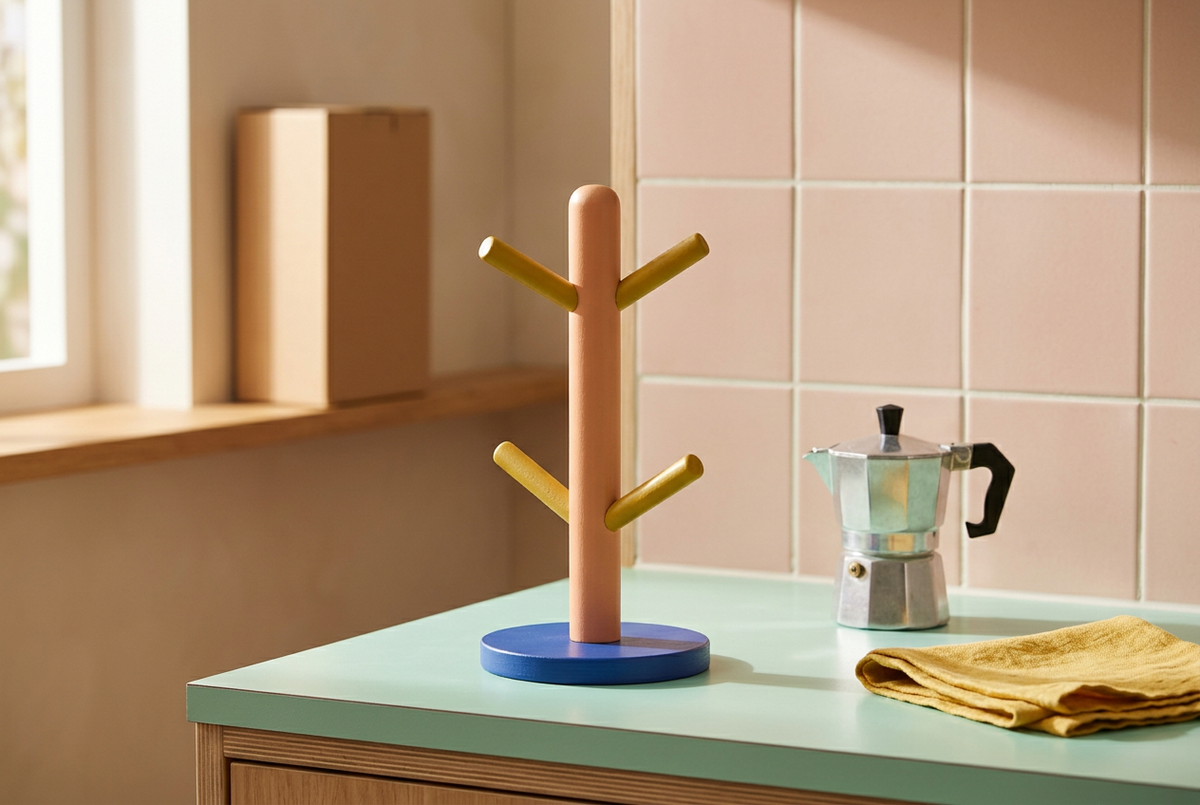
Sipbranch Colorful Freestanding Kitchen Mug Tree with Four Mustard Pegs, Apricot Post & Cobalt-Blue Round Base
Sipbranch Colorful Freestanding Kitchen Mug Tree with Four Mustard Pegs, Apricot Post & Cobalt-Blue Round Base
Couldn't load pickup availability

🌿 Give Your Favorite Cups a Branch of Their Own
Not every cup needs to disappear behind a cupboard door. There are the ones you choose almost without thinking: the small cup for the first coffee, the familiar handle that fits your fingers, the pair you bring out when someone stays for a drink. Sipbranch gives suitably sized handled cups a visible place in the kitchen.
A cobalt-blue circular base anchors an apricot-colored upright post. Four mustard-yellow pegs rise outward in two levels, creating a branching silhouette that is recognizable even when empty. It is an open display accessory rather than an enclosed storage container, with color carried by the structure itself instead of printed decoration.
Meet the Shape Before You Meet the Routine
One circular foundation. The blue base gives the display a defined footprint on the countertop. Its low, flat form contrasts with the height of the central post, introducing a strong horizontal element beneath the branching pegs.
One rounded upright. The apricot post runs through the center and finishes with a rounded top. Its plain cylindrical outline keeps the overall design legible, leaving the yellow pegs to form the more expressive part of the silhouette.
Four upward-angled pegs. The pictured design has two peg positions at the upper level and two lower down. Their upward angle creates the branch-like appearance. They are shown as fixed elements, not folding arms or an adjustable mechanism.
Three separate colors. The blue belongs to the base, apricot to the post and yellow to the pegs. Because each color follows a structural part, the palette feels organized rather than scattered across the surface.
🍵 Think of It as a Small Cup Collection, Not a Full Cupboard
Sipbranch is most naturally styled with a restrained selection of suitable handled cups. The photographs demonstrate small cups rather than oversized drinkware. Leaving some pegs empty lets the colors remain visible and creates space between the pieces you choose to display.
Four pegs describe the layout, not a verified promise that four mugs of any size or weight can be loaded together. Cup height, handle opening, body width and weight all affect suitability. The physical product's dimensions and supported load must be confirmed before selecting your arrangement.
Check that each cup handle clears the peg comfortably, that the cup hangs without pressing against the post, and that neighboring pieces do not collide. If a cup cannot sit securely or makes the stand unstable, it belongs on a shelf instead.
A Conversation Between the Cup and the Counter
“This is the one I use every morning.”
Place your chosen cup where it can be reached without moving other objects. Before preparing the drink, lift its handle clear of the peg and set it down on the counter. The display keeps the cup visible between uses; it is not a stand for holding a cup while pouring a hot beverage.
“Would you like one too?”
A pair of compatible cups can make a beverage area feel ready for company. Give both pieces enough separation and keep a clear patch of countertop for setting them down. The host's small advantage is simply knowing where the cups are, without having to search among stacked dishes.
“That one deserves to be seen.”
Perhaps a cup has an interesting shape or a color you enjoy. An open display lets it contribute to the room instead of remaining hidden. Choose the display arrangement for fit and stability first, then let color and personality guide the finishing touches.
🧭 Map Out the Space Around It
The base is only the starting footprint. Hanging cups extend beyond the central post, and removing them requires space above and around their handles. A tight corner that fits the empty stand may not work once cups are present.
Choose a level, dry countertop well away from its edge. Allow clearance from cabinet doors, nearby appliances and the main preparation route. Keep the display out of places where a passing sleeve or a moving cutting board could catch a cup.
A beverage area can be convenient, but avoid heat, steam and splashing water. Do not set the stand on an appliance or beside an open flame. The design is presented as countertop display, not as a sink-side drying rack or a heat-resistant kitchen tool.
How to Build a Considered Arrangement
- Start empty. Place the stand on the chosen surface and check the space around all four peg positions before adding drinkware.
- Compare the handle and peg. A compatible opening should clear the peg without force. Avoid handles that wedge tightly or leave the cup perched near the end.
- Add one suitable cup at a time. Keep a hand nearby while checking how the arrangement sits. Observe spacing and balance rather than assuming every peg should be occupied.
- Leave room between pieces. If cup bodies touch one another or strike the post, reduce the number displayed or choose smaller compatible pieces.
- Take cups off before moving the stand. Support the base when repositioning it rather than carrying a loaded display by a peg or the top of the post.
Do not use the pegs for filled cups, heavy jugs, pans or unrelated hanging loads. Confirm the supplied item's load guidance rather than estimating capacity from the photographs.
🎭 Two Personalities, Depending on What You Display
With plain ivory cups, the three product colors take the leading role. The cups become quieter shapes around the yellow branches, while blue and apricot remain visible underneath. This approach works well when the surrounding kitchen already has several colorful accents.
With compatible colored cups, use one repeated shade to connect the display to the room. A yellow cloth nearby or a muted pink backsplash can echo the stand without matching it exactly. Keep the arrangement sparse enough that the silhouette still reads clearly.
Empty, Sipbranch has a different character: a graphic upright object with four short branches. That makes it possible to enjoy the form between uses without feeling that every position needs to be filled.
Before Choosing Your Cups
The images establish the intended design: one blue round base, one apricot post and four mustard-yellow pegs. They do not establish material composition, a non-slip underside, a weighted base or resistance to tipping. Exact measurements, assembly requirements, load limits and care instructions should be checked against the physical supplied product.
This is not presented as a universal fit for every mug or a guarantee against breakage. Inspect the stand and drinkware before use, choose an appropriate location, and discontinue an arrangement if any connection appears loose or the display does not sit securely.
The Product, Separate from the Scene
The product concept is one freestanding four-peg mug tree in the colors shown. Its packaging design is a tall plain kraft-brown rectangular carton without a printed logo. Ivory cups, coffee pots, textiles, shelves and other kitchen accessories in the photographs are styling props and are not included.
Let the Cups You Enjoy Become Part of the Room
A favorite cup has a way of belonging to a particular moment. Sipbranch gives suitable pieces a place between those moments: visible, individually arranged and framed by a little color. Choose a small selection, give it room, and make the drink-preparation area feel more personal without trying to display the whole cupboard.