Gatherglow Colorful Rectangular Serving Tray with Raspberry-Pink Interior, Lilac Rim & Twin Lemon-Yellow Arch Handles
Gatherglow Colorful Rectangular Serving Tray with Raspberry-Pink Interior, Lilac Rim & Twin Lemon-Yellow Arch Handles
Couldn't load pickup availability

🫖 A Cup, a Plate, and a Little Room for a Pause
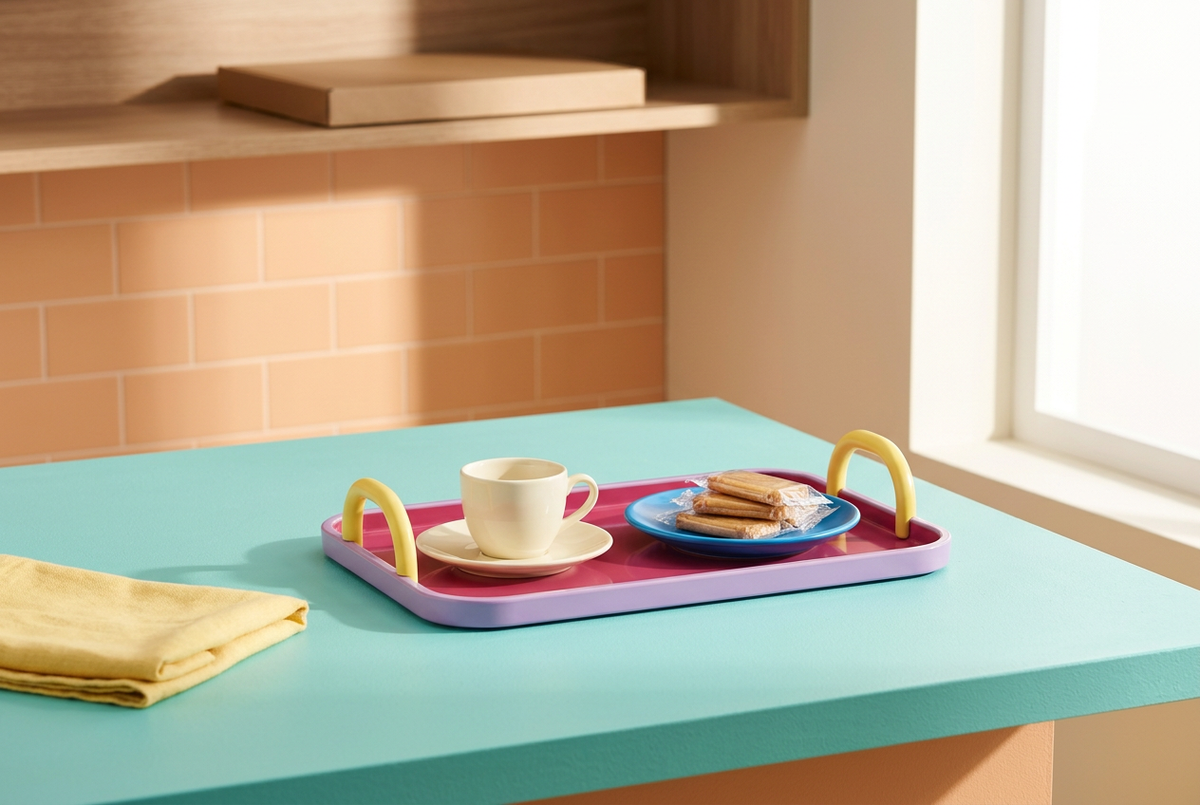
There is a difference between setting a cup down wherever it fits and giving a break its own small setting. Gatherglow is made around that second idea: an open rectangular tray that visually brings a few separate pieces together, framed by lilac and finished with two lemon-yellow arches.
The raspberry-pink interior creates a warm field beneath your arrangement. A low raised rim follows the rounded rectangular outline, while the handles sit at the two short ends. With an ivory cup, a small plate or a folded napkin in place, the tray becomes a defined composition rather than another patch of countertop.
It does not need an elaborate spread. A restrained arrangement lets the color show and gives each object a little space of its own.
The Arrangement Comes First
Begin with one anchor piece
A suitably sized cup and saucer make an easy starting point. Set them within the interior rather than balancing the saucer against the raised edge. Leave enough space around the cup handle to pick it up without touching another object.
Add one companion
A small plate or folded napkin can complete the setup. Keep food on appropriate plates or in suitable packaging, rather than directly against the tray. The photographs use separate dishes and wrapped snacks to demonstrate this approach.
Stop before the surface disappears
Not every part of the pink interior needs to be covered. Visible space between the pieces helps the tray read as a single setting. It also makes it easier to see where one object ends and another begins when you reach for a cup or plate.
🟣 Follow the Outline
The interior is uninterrupted. The pictured tray has a single flat central area without compartments, fitted cup wells or dividers. Your arrangement is not restricted to a fixed pattern, but the size of each item still needs to suit the available surface.
The border is low and continuous. A lilac outer edge follows the tray perimeter and rounds each corner. It defines the arrangement visually without forming the high walls of a storage box. The rim should not be treated as a promise that liquids cannot spill or objects cannot slide.
The handles rise at opposite ends. Two yellow arches create a matching pair across the shorter sides. Their curved shapes contrast with the longer horizontal lines of the tray, adding a distinct silhouette even when it is empty.
The palette has three clear jobs. Pink provides the background, lilac traces the outline, and yellow marks the ends. The colors follow the structure rather than appearing as a printed pattern across it.
A Little Scene, Three Different Ways
The afternoon interval
Set the tray on a level counter or table with a cup and a small plate. Give the setting a little distance from the busiest preparation area. It becomes a place to put down what belongs to the break, separate from the utensils and ingredients still in use nearby.
The guest's place
For a casual visit, arrange the pieces before your guest arrives. A cup, a folded napkin and a separate plate can look considered without matching every color. Keep the tray fully supported by the table and leave the cup handle easy to approach.
The tidy beverage corner
Between drinks, use the empty tray to define a small countertop area for suitable lightweight accessories. Do not crowd it with a permanent collection of heavy bottles or appliances. The design is a serving and presentation accessory, not a structural shelf or an appliance platform.
🟡 Use Color as the Starting Point, Not the Whole Plan
Plain ivory tableware lets the pink interior remain the strongest note. A blue plate adds a cooler contrast, while a white napkin gives the arrangement a quiet area. You do not need to repeat all three tray colors in every setting.
For a softer room, place Gatherglow against pale wood, cream or muted peach. For a livelier kitchen, an aqua countertop or a yellow textile can connect it to the surroundings. Keep nearby patterns restrained if you want the rim and handles to remain easy to read.
The empty tray has a different presence from the styled one. Without dishes, its interior becomes a broad block of color; with a small arrangement, that color frames the objects instead. Both appearances are part of its visual appeal.
Before Anything Moves
The images show the tray resting on a supporting surface. They do not establish a tested carrying load, handle strength, non-slip finish or spill resistance. Confirm the physical product's load limits and handling instructions before using it to carry dishes or drinks.
When arranging items, check that their bases sit flat inside the border, that nothing overhangs, and that the total setup is appropriate for the supplied product. A cup that looks small from above can still be heavy when filled. Avoid treating empty-cup styling photographs as evidence for carrying hot or heavy contents.
If carrying is permitted by the supplied instructions, use both designated handles, keep the tray level and follow the stated load limits. Do not lift it by one handle, the rim or a dish resting on top. For an uncertain or awkward load, move the objects separately instead.
A Practical Placement Note
Check the full footprint, including the space needed to reach both handles. A surface that fits the rectangle tightly may still make the ends difficult to access. Keep the tray away from table edges, unstable furniture and routes where it could be knocked.
Use a dry, level supporting surface. Do not balance the tray across a sink, rest it on a narrow ledge or use it as a freestanding lap table. No legs, folding stand or cushion are shown in this design.
Keep it away from open flames, burners and hot cookware. The tray is not presented as a trivet, baking tray or heat-resistant surface. Hot-drink suitability and cleaning requirements depend on the actual material and finish, which need confirmation from the supplied item.
🟠 What Changes the Look Most?
Spacing. Two pieces with a little room between them often make a clearer arrangement than several tightly packed objects. The exposed pink surface creates separation without adding another accessory.
Height. A single cup beside a low plate lets the handles remain visible. Tall objects can obscure the outline and may make a setup less convenient, so choose the arrangement for use as well as appearance.
Contrast. A quiet cup and a cooler-colored plate let the tray provide the brighter accents. If the dishes are patterned, keep the remaining accessories simple rather than adding competing decoration.
The Tray and the Photograph Are Not the Same Set
The product concept shown is one rounded rectangular tray with a raspberry-pink interior, lilac rim and two lemon-yellow arch handles. Its packaging design is a flat kraft-brown rectangular carton without a printed logo.
Cups, saucers, plates, wrapped biscuits, napkins and kitchen furnishings are styling accessories and are not included. Exact dimensions, material composition, weight capacity, handle construction and care requirements should be verified against the supplied physical item before purchase. Direct food-contact, dishwasher, microwave and oven suitability are not established by the images.
Bring a Few Things Together, and Let That Be Enough
Gatherglow gives a small arrangement a clear beginning and end: pink beneath it, lilac around it, yellow at either side. You choose the cup, the plate and the moment. The tray contributes the frame.
Make a little space, arrange only what belongs there, and let an ordinary pause feel more deliberately set.